Bibs, Floodlights and the Lift Home: Why the Rusty Tuesday Five-a-Side Still Counts
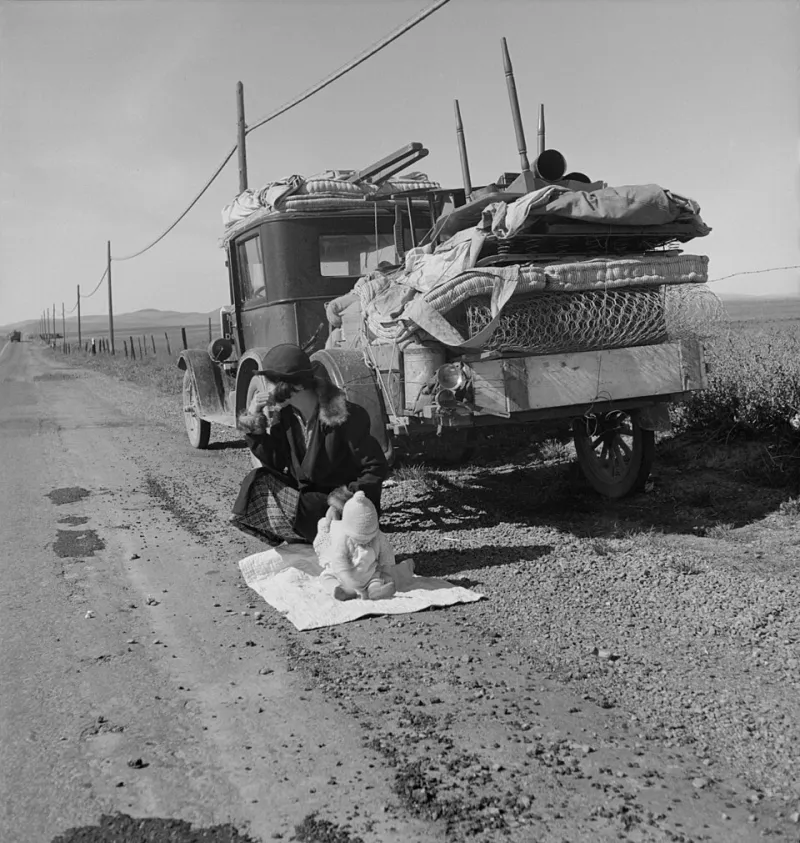
Photo: Dorothea Lange / Adam Cuerden, Public domain, via Wikimedia Commons
There is a particular kind of cold that lives in a council leisure centre car park at ten past eight on a Tuesday in November. It gets into the ankles first. It smells faintly of diesel and wet leaves. And somewhere beyond the fence, under floodlights that hum like a fridge, a group of adults in mismatched kit are trying to remember which way they are supposed to be passing.
This is not elite sport. Nobody is being scouted. The pitch is probably boggy at one end, the bibs smell of old fabric softener and defeat, and at least one person has brought the wrong shoes. And yet this weekly appointment — low-stakes, badly attended by talent, reliably cold — is one of the more honest forms of everyday endurance going.
Sisu is often imagined as a lone struggle against something enormous. More often, it is the quieter discipline of honouring a commitment when you are tired, rusty and plainly not at your best. The Tuesday five-a-side is that discipline in its most ordinary form.
The Walk to the Pitch Is Half the Job
The hardest part is rarely the football. It is the bit before: the internal negotiation on the sofa, the realisation that your kit is still damp, the walk from the car with a bag over one shoulder while your breath turns to fog. Everything in your body is making a reasonable case for staying in.
The Finnish idea of sisu is sometimes translated as grit, but it is closer to a kind of stubborn continuation — carrying on when the finish line is not glamorous and nobody is clapping. Turning up to a Tuesday game in the rain is not heroic. It is, however, a small act of self-respect. You said you would be there. Someone is bringing the balls. The team will notice if you do not.
That last point matters more than it sounds. Everyday endurance is rarely built in isolation. It is built in the small, unglamorous web of people who expect you to show up — and who are quietly glad when you do, even if your first touch is a tackle on your own teammate.
Nobody Is Scouted on a Tuesday
There is freedom in playing a sport you are not especially good at. Grassroots five-a-side is full of people who used to be decent, people who never were, and people who are mainly there for the runaround and the post-match chips. The standard is whatever the standard is. The score is forgotten by Wednesday.
This is worth defending. So much of adult life is organised around performance, measurement and the quiet fear of being found out. A Tuesday night game offers the opposite: a space where effort counts for more than outcome, and where a misplaced pass is met with a shrug rather than a review meeting.
Turning up badly is not a failure of sisu. It is sisu in its everyday clothes. The missed passes, the heavy legs, the moment you realise you are marking the wrong person — none of it undoes the fact that you got out of the house, into the cold, and onto the pitch. That is the work. The football is just the format.
The Bib Economy
There is an entire social system in a bag of bibs. Someone brings them. Someone forgets them. Someone argues that the dark blue ones are actually green. The distribution of bibs is never fair, the teams are never even, and the goalkeeper is usually whoever is least willing to argue.
This is not a flaw. It is the point. Grassroots sport runs on small, unglamorous contributions: the person who books the pitch, the one who brings the balls, the one who remembers the first-aid kit, the one who gives a lift to the person whose car is in the garage. None of it is impressive. All of it is infrastructure.
Recovery, in the broader sense, works the same way. It is not built by grand gestures. It is built by a series of small, repeatable acts that hold a week together. A Tuesday game is one of them. So is the lift home.
The Warm-Down That Isn’t a Warm-Down
After the final whistle, there is the bit that never makes it into the match report: the slow walk back to the car, the argument about whose turn it is to bring the ball, the pub that is still open and does a decent plate of chips. This is where the actual recovery happens.
Not the stretching. The talking. The debrief that is not really a debrief — a rambling conversation about work, knees, the state of the pitch, and whether anyone actually knows the offside rule. It is social recovery, and it matters as much as the match itself. Maybe more.
Sisu has a reputation for solitary endurance, but the concept is not a licence to isolate. The Finnish word is often linked to collective resilience as much as individual grit. The pub debrief is not a reward for the exercise. It is part of the exercise — the bit where the nervous system notices that the cold, the effort and the mild humiliation are over, and that you are among people who are glad you came.
Small Rules for Turning Up Badly
If you are trying to build a winter habit that holds, the Tuesday five-a-side offers a few transferable lessons.
First, lower the bar until it is almost embarrassing. The goal is not a good performance. The goal is arrival. Kit in the car the night before. Boots by the door. A lift arranged. Remove the friction and the negotiation gets shorter.
Second, let the team be the accountability. A group chat that asks who is in this week is more effective than any personal pledge. You will turn up for people. You will not always turn up for a plan.
Third, protect the debrief. The pub is not optional admin. It is the recovery. If you have to choose between ten extra minutes of running and ten minutes of sitting down with the group afterwards, choose the sitting down.
What Sisu Looks Like in a Leisure Centre Car Park
It looks like a middle-aged defender with a bad knee, jogging back into position because the team is short. It looks like the person who brings the bibs every week and never mentions it. It looks like the lift home given without fuss, and the message afterwards that says same time next week.
None of this is dramatic. That is the point. Everyday endurance is not built on the days when you feel brilliant. It is built on the Tuesdays when you feel rusty, the pitch is boggy, and you go anyway.
The floodlights will still be humming. The bibs will still smell. And the team will notice that you turned up.